Your Scalp Is Skin — Treat It Like It
You moisturize your face. You exfoliate your body. But your scalp — the skin that determines the health, thickness, and growth cycle of every strand of hair on your head — gets shampoo and hope.
A scalp treatment is a professional service designed to address the specific conditions happening on your scalp right now. Not a generic product. Not a salon add-on squeezed between a cut and a blowout. A dedicated session focused entirely on your scalp environment — the oil balance, hydration levels, follicle health, buildup, and circulation that your hair depends on to grow well.
Think of it the way dermatologists think about skin: you would not use the same face wash for acne, rosacea, and dehydration. Your scalp deserves the same specificity.
What a Scalp Treatment Actually Addresses
The list of conditions that respond to professional scalp treatment is longer than most people expect:
Excess oil and sebum buildup — When your scalp overproduces oil, follicles get clogged and hair looks greasy hours after washing. A treatment rebalances sebum production at the source.
Dryness and flaking — Not all flaking is dandruff. Dehydrated scalp skin sheds visibly and creates irritation that drugstore shampoos often make worse, not better.
Product residue and environmental buildup — Months of dry shampoo, styling products, and hard water minerals create an invisible layer that sits on your scalp and blocks everything you put on it from actually working.
Thinning and increased shedding — When follicles are congested, inflamed, or starved of circulation, hair growth slows and shedding increases. Clearing the environment gives follicles room to function.
Tension and stress-related scalp tightness — Your scalp holds more tension than you realize, especially along the temples, crown, and the occipital ridge at the back of your skull. Targeted massage techniques address this directly.
The Problem with Most Scalp Treatments
Here is what happens at most places that offer scalp treatments: a stylist applies a product, massages your head for a few minutes, and rinses. Maybe they use a scrub. Maybe they recommend a shampoo to buy on the way out.
What they do not do is look at your scalp first.
That matters more than most people realize. Applying a hydrating treatment to a scalp that is actually congested with oil makes the problem worse. Using an aggressive exfoliant on an irritated, sensitive scalp creates more inflammation. Without knowing what is actually going on beneath the surface, every treatment is a guess.
Most scalp treatments fail not because the products are bad — but because nobody checked what the scalp actually needed before reaching for a bottle.
What a Real Scalp Treatment Looks Like — The System Around the Camera
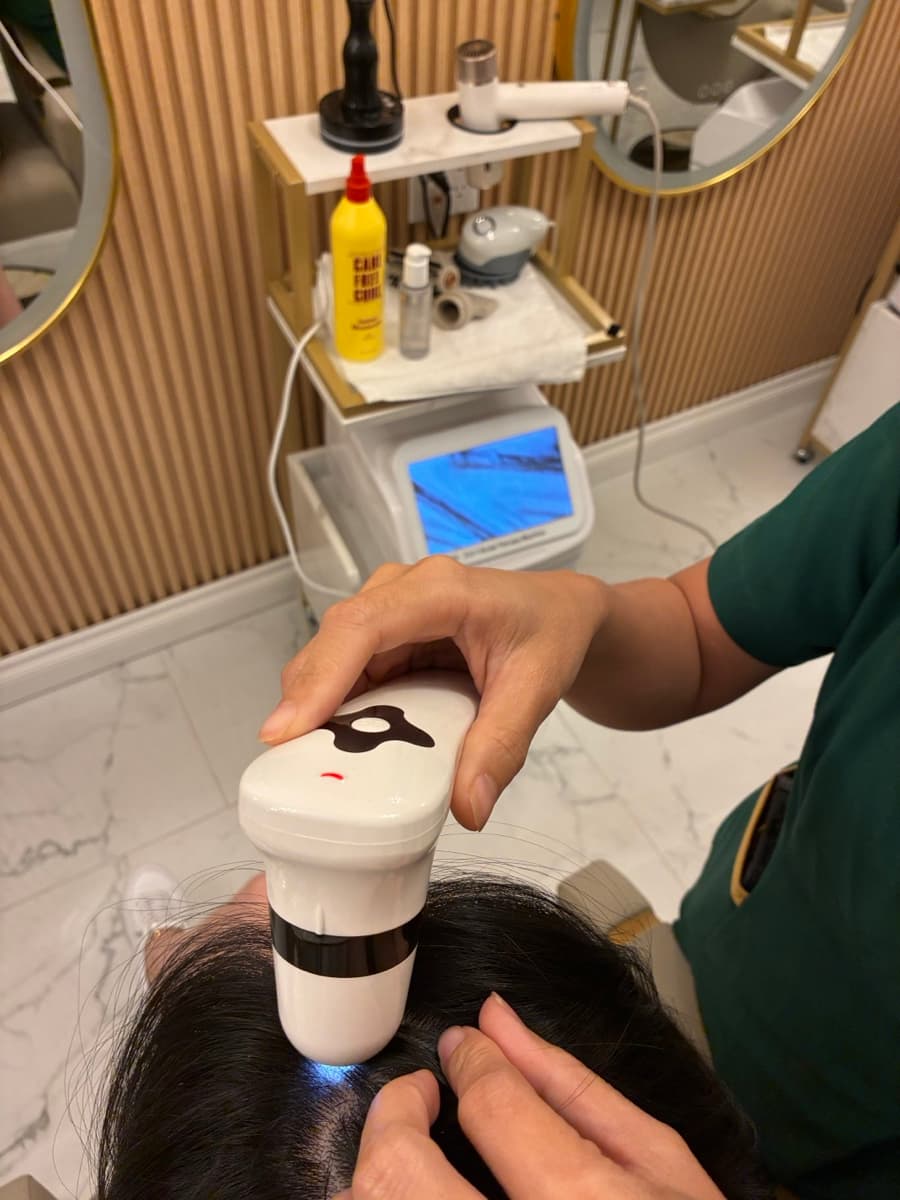
Almost every modern head spa in the region now has a scalp camera — that part has become industry standard. What we think actually makes a scalp treatment useful is the system around the camera. At Lavie Bella, every scalp treatment follows four steps, in order:
1. Intake questionnaire. Before the camera ever comes on, every guest fills out a detailed intake — concerns, history, routines, products you're using at home, stress patterns, the small things you've noticed about your scalp that you've probably never said out loud. Context on you as a person, not just an image of your scalp. The same flaking pattern can mean very different things depending on routine and history.
2. Scalp analysis at 50x and 200x magnification, mapped against 8 areas. Your therapist scopes the scalp across crown, hairline, temples, mid-scalp, nape, and the zones between — because your crown might be oily while your hairline is dehydrated, and a quick "scalp overview" with the camera can miss that entirely. The 8-area scope is what lets us see the whole map instead of a few snapshots. The areas your therapist reads receive a condition score.
3. Treatment calibrated to what the scan showed. Not a generic menu — a protocol matched to the condition scores from that day. Enzyme-based cleansing for product residue. Chelating for mineral deposits. Hydrating treatments for dehydrated zones. Oil-balancing for congested areas. This is the reason two guests sitting in adjacent rooms can receive completely different treatments from the same therapist on the same day.
4. Written verdict and care plan. You leave with a documented read of what was found in each area and a written between-visits roadmap based on that read.
The camera is the tool. The intake, the 8-area scope, the verdict, and the care plan are what turn a camera session into something you can actually use. This is our Scalp Reset protocol.
What Happens During the Session
Once your scalp analysis is complete and your therapist has identified what each area needs, the treatment follows a structured flow:
Deep cleansing — Professional-grade cleansing removes the layer of buildup that regular shampooing leaves behind. Depending on what the camera revealed, this might be enzyme-based cleansing for product residue or chelating treatment for mineral deposits from hard water.
Targeted treatment application — Serums, masks, or treatment solutions are selected and applied based on your specific condition scores. Hydration for dehydrated zones. Oil-balancing formulations for congested areas. Calming treatments for irritated sections.
Extended scalp massage — Not a two-minute afterthought. A sustained therapeutic massage that improves circulation, releases tension, and activates pressure points across the scalp, temples, and neck.
Rinse and finishing — A final cleanse locks in the treatment benefits and leaves your scalp feeling genuinely different — lighter, cleaner, and more balanced than any home wash has ever achieved.
The Verdict Report: Proof, Not Promises
At the end of your session, you leave with something no other scalp treatment gives you: a Verdict Report.
This is a documented summary of what your scalp analysis found, what treatments were applied, and a care roadmap for what to do between visits. It is your scalp's health record — not a sales pitch for products, but an honest snapshot of where things stand.
For guests who come back regularly, the Verdict Report becomes a progress tracker. You can compare your scalp environment across visits and see whether the changes you have made — at home and in-studio — are actually working. That kind of accountability is something no at-home product can offer.
Professional Scalp Treatment vs. At-Home Care
Let us be honest: a good home routine matters. Using a gentle, sulfate-free shampoo, exfoliating weekly, and avoiding product overload will keep your scalp in reasonable shape between professional sessions.
But there are things home care simply cannot do:
See what is happening — A bathroom mirror shows your hair. A 200x magnification camera shows your follicles, sebum levels, and scalp surface. That is a fundamentally different level of information.
Differentiate buildup types — Hard water mineral deposits, product residue, and excess sebum all look like "buildup" from the outside. They require completely different treatments. At home, you guess. In a professional setting, you know.
Reach the depth — Consumer products are formulated for safety at home, which means they are less concentrated than professional formulations. A professional scalp treatment clears buildup and treats conditions at a level your shower routine cannot match.
The ideal approach is both: professional scalp treatments on a regular cadence, with informed home care between visits. Your Verdict Report tells you exactly what that home care should focus on.
Who Should Get a Scalp Treatment?
Scalp treatments are not reserved for people with visible problems. Some of the most common guests at Lavie Bella:
People who have tried everything at home and nothing seems to work. Often, the issue is not the products — it is an underlying scalp condition that needs professional attention first.
People noticing more hair in the drain than usual. Buildup-related shedding is often reversible once the follicle environment is cleared.
Anyone who has never had their scalp professionally assessed. You might be surprised by what the camera reveals — and relieved to finally know what is going on.
People who simply want to invest in the foundation their hair grows from. The same way a facial keeps your skin healthy, periodic scalp treatments keep your scalp functioning at its best.
If you are curious about what your scalp actually looks like beneath the surface, our Scalp Reset at Lavie Bella Head Spa in Artesia, California is designed to show you — and then do something about it.
Frequently Asked Questions
How often should I get a scalp treatment? For most people, every four to six weeks is the sweet spot. Your therapist will recommend a specific cadence based on your scalp analysis results and how quickly your scalp environment changes between visits.
Does a scalp treatment help with hair growth? A scalp treatment creates the conditions for healthier hair growth — clear follicles, balanced oil production, improved circulation. It does not replace medical treatment for conditions like alopecia, but for buildup-related thinning and shedding, the results can be significant.
Is it painful? Not at all. The experience is deeply relaxing. The scalp massage alone is something most guests describe as the highlight of their visit. If you have areas of sensitivity, your therapist adjusts pressure and technique accordingly.
How is this different from a salon scalp treatment? Time, depth, and structure. A salon add-on runs 10 to 20 minutes with no analysis. A dedicated scalp treatment at Lavie Bella runs 60 to 90 minutes, starts with an intake questionnaire, moves into a scalp camera analysis mapped against our 8-area scalp map, and ends with a written Verdict Report and care plan you take home.
What should I do between visits? Your Verdict Report includes specific home care recommendations based on your scalp condition. Generally: gentle shampoo, weekly exfoliation, and avoiding product overload. Our complete scalp care guide covers the fundamentals in more detail.